
Our Secret Weapon: Stirring Books on Our Homeland’s 3,000 Years
#1314 March 22,, 2026
Our Jewish people’s homeland has NEVER been as internationally vilified as in these days. This affects its Diaspora supporters like you and me, as does so much of our U.S. Jewish community not sharing our homeland pride and support. Here’s my plea: Read a moving book about Israel, and plead with a less supportive fellow to read it.
Our Secret Weapon: Stirring Books on Our Homeland’s 3,000 Years
It’s human nature to collect stuff, but I didn’t collect stamps or coins like normal folks. Through a half-century’s haunting of “used” book stores and Jewish neighborhood library book sales, I’ve amassed, my database says, a home library (ok, shared with a parrot) of over a thousand non-fiction books about Israel, ancient and modern, of which I’ve read a measurable fraction. (The parrot hasn’t read any, just recycles those he gets hold of.)
Don’t get me wrong. I’ve always regarded “history” books, at least those to which I was subjected long ago in high school, as among the most boring books ever written. But not some of these stirring, gripping accounts, especially first-person accounts, of our Jewish people’s historic homeland of Israel. Today, with Israel being subjected to unprecedented calumnies of “occupation … apartheid … genocide!” etc., I urge you to read one or more of the most moving (you can get them used or sometimes new on Amazon or abebooks.com). It’ll invigorate your pride in support of our homeland and people. But, more than that, I’d have you implore those of our tribe here in America who are less passionate on Israel than us to read and discuss with you one or more of these moving books. There has never been a moment during our generation’s time here in America when unity of our community in support of our people’s homeland of Israel was more needed, and alas less in evidence.
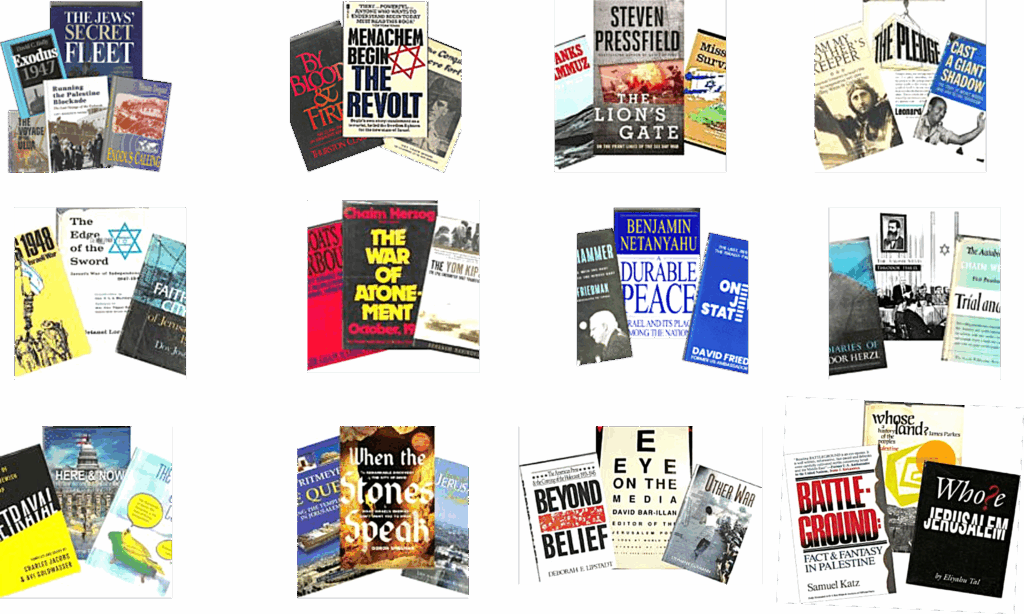
That photo above is a collage of those of categories on this website, confrontingjewishissues.com, of stirring Israel books I recommend. On the main menu, click “Grassroots American Jewish Street,” on the top menu, then “Israel For Us Grassroots,” then “Gripping Books on Our People’s Homeland of Israel.” That’ll take you to my recommendations. Or simply just click this direct link to that page. Click one of the twelve categories, and that’ll take you to a page with a half-dozen or so book covers with what’s-inspiring-about-them according to me. Here goes:
Archeology: The oldest part of Jerusalem is the City of David, just south of the Old City. Doron Spielman’s new When the Stones Speak tells of his presence and involvement in the unearthing of King David’s palace, the Siloam Pool and Pilgrimage Road connecting the Pool to the Temple Mount, all of immense significance to both Christians and Jews. I commend to you also Pompeo & Friedman’s DVD, Route 60: The Biblical Highway, from north to south, of equal significance. The first two nights it was shown in American theaters, Route 60 sold more tickets than any other film. And I’d have you read Leen Ritmeyer’s Secrets of Jerusalem’s Temple Mount. Much of Herod’s Mount still stands, and he makes what Biblical Archeology Review called “quite a good case” that still visible today on Mount Moriah’s summit, es-Sakra, the Foundation Stone, the Rock enshrined in the Dome of the Rock, that had before that been the floor of the Holy of Holies of our people’s two Jewish Temples, is the slot carved three millennia ago by King Solomon as the resting place of the Ark of the Covenant!
Continuous Presence: No, we weren’t exiled by Rome. Historian Parkes wrote in Whose Land? A History of the Peoples of Palestine that Jews’ continuous tenacious post-Biblical presence all through the centuries, in spite of every discouragement, wrote today’s Israelis’ “real title deeds.” Samuel Katz included a chapter on our continuous homeland presence in his classic Battleground: Fact & Fantasy in Palestine that PM Begin called “the most moving chapter in the book.” Tal’s Whose Jerusalem is a minutely detailed account of Jewish connection to our homeland’s capital city. So taken was I with Parkes’ assertion, I wrote a book, Israel 3,000 Years, documenting that continuous Jewish presence.
Zionism: There should not be a Jewish home on the planet without Herzl’s Jewish State on a bookshelf. For a fuller view of the man is his Diaries, surprisingly readable and containing this assertion, that at his First Zionist Congress at Basel, Switzerland in 1897, he’d founded the Jewish state, that if he’d said that aloud people would laugh, but in 50 years they’d perceive it. In 1947, fifty years to the year, with the UN’s proclaimed partition of western Palestine into Arab and Jewish states, everyone did. Herzl flashed across the Jewish scene like a comet, dying young, followed for a full lifetime by Chaim Weizmann, whose autobiography Trial & Error is a Zionist’s must read out of respect to this man.
Aliyah Bet: The sad fact is that the British held Europe’s Jews arms behind their backs while the Germans gassed them. Before, during and most effectively after the Holocaust, Palestinian Jews, aided by US WWII vet volunteers, sailed Hitler’s survivors in rickety ships into the teeth of Britain’s anti-Jewish Palestine blockade. The nine books – Commander of the Exodus, Operation Exodus, Exodus 1947 (Gruber, Holly), Exodus Calling, Grauel, The Jews’ Secret Fleet, Running the Palestine Blockade, Voyage of the Ulua – I cite on this Aliyah Bet page, first-person accounts of the courage of crew and survivors alike, are among the most stirring and gripping books of any genre you’ll ever read.
Versus the British: Menachem Begin’s The Revolt is standard reading for the world’s revolutionaries, and should be for us American Jews. The British reneged on their role as trustee of the Palestine Mandate by forcefully opposing Jewish immigration to Israel before, during and even after the Holocaust and barring purchase of land in Palestine by Jews. In The Revolt Begin chronicled the Irgun’s struggle against the British, which the Haganah sometimes supported and sometimes opposed. I also recommend Bell’s Terror Out of Zion and other accounts of Palestinian Jews against the British.
War of Independence: Netanel Lorch’s The Edge of the Sword is the standard work on the 1948 War, but Kurzman’s Genesis 1948 and Collins & Lapierre’s O Jerusalem are more gripping reads. Sharef’s Three Days and Dov Joseph’s The Faithful City are accounts of key participants’ stirring roles.
Americans for Israel 1948: Leonard Slater’s The Pledge is a great read on efforts here in the U.S. to help Israelis in the face of America’s ban on military aid. Greenfield & Hochstein’s The Jews’ Secret Fleet covers U.S. war vets’ volunteer roles in all ten America-sourced Aliyah Bet ships. Ted Berkman’s Cast a Giant Shadow is a thorough look at Mickey Marcus’ contribution to the IDF. Jeffrey & Craig Weiss’s I Am My Brother’s Keeper covers North American volunteers’ role, and is, as Bibi put it, “riveting.” Steven Pressfield’s The Lion’s Gate, mainly on the Six Day War, covers U.S. fighter pilot Lou Lenart’s long involvement for Israel. All these books on American Jews involvement should enhance your pride.
Six Day War: Among the lot of moving books my favorite is Steven Pressfield’s The Lion’s Gate that in the words of a few selected IDF officers and men places you “in the cockpit, inside the tank, under the helmet.” Yael Dayan’s Israel Journal June 1967, Eric Hammel’s Six Days in June, Bondy et al’s Mission Survival, Rabinovich’s The Battle for Jerusalem, Teveth’s The Tanks of Tammuz, Moskin’s Among Lions, Oren’s Six Days of War and Narkis’ Liberation of Jerusalem are moving reads.
Yom Kippur War: Chaim Herzog’s The War of Atonement and Abraham Rabinovich’s The Yom Kippur War are moving accounts covering from Israel’s being taken by surprise through ultimate victory and lessons learned. Avigdor Kahalani’s The Heights of Courage, by that hero of “The Valley of Tears,” will tell you how desperately close things were. Among the most exciting books you’ll ever read is Abraham Rabinovich’s The Boats of Cherbourg, covering these missile boats and their weapons and counter-weapons from the inception of Israel’s early dilemma that it couldn’t build a conventional navy through the missile boats’ and weapons development and astounding functioning in the Yom Kippur War.
American Jews: This is not a happy subject. Jacobs & Goldwasser’s Betrayal: The Failure of American Jewish Leadership is a collection of highly-documented essays revealing that failure. Dr. Ken Levin’s The Canary on the Couch is a psychiatrist historian’s diagnosis. A chapter of my Here & Now: U.S. Jews and the Issues Confronting Us cites a series of recent years’ leadership and grassroots’ failure of support for our people’s homeland.
Anti-Israel Media Bias: David Bar-Illan’s Eye on the Media is a collection of this Jerusalem Post editor’s groundbreaking columns pointing the way for the rest of us media watchers to contest the media’s loaded lexicon of Jewish homeland delegitimizing pejoratives. I cite a half-dozen other works, including my own Pressing Israel: Media Bias Exposed From A-to-Z, exposing the bias.
Alternatives to “The Two-State Solution”: By me, ripping from Israel historic Jerusalem and Judea-Samaria heartland would render our Jewish national home an indefensible Jewishly meaningless Jewish national ghetto. I’d have you read in succession Amb. David Friedman’s Sledgehammer, then One Jewish State, offering Palestinian Arabs, in addition to their majority in three-quarters of Mandated Palestine, judenrein Jordan, internal autonomy (“less than a state,” as Rabin had proposed) in portions of Judea-Samaria, to which Israel will finally apply sovereignty (not “annex” as though foreign). I also commend to you Netanyahu’s Durable Peace and Michael Oren’s Ally.
Bottom Line
In the face of much of the world today viciously vilifying our people’s historic homeland, we American Jews must be in the forefront in confidently making the case that the land of Israel, historic Jerusalem and Judea-Samaria heartland at its very core, has for three millennia been, is today and will remain our Jewish people’s national home. Reading and urging others to read these stirring gripping books that I cite on my website will help.
Comments by reply to emailed #1314:
Additional suggestions by Myron Sugarman:
Jerry, Your suggestion is excellent, for what is the study of history? The equal partner to human experience, and what is the result of studying history combined with human experience? … wisdom.
And what does King Solomon say about wisdom? “It’s a divine gift, paramount above wealth and a long life.”
I would also add “Our Man in Damascus,” the story of Elie Cohen, the greatest spy story ever!
And “A Tzaddik In Our Time,” the story of Rabbi Aryeh Levin, the Rabbi of the prisons during the British Mandate and Occupation.
And if one wishes to understand the greatest mind of the Zionist Movement, “The Lone Wolf” by Shmuel Katz, the story of Vladimir Zev Jabotinsky, the founding father of the Revisionist Zionist Movement.
And Lastly, “Rebbe, Life and Teachings of Menachem Schneerson, The Most Influential Rabbi in Modern History,” by Joseph Telushkin.
= = = = =
From Dan Bacine: “I’m surprised you didn’t include Max Dimont’s Jews, God and History”
Me: “Oops, should have. Quite a read. Doubtless, you’re the first of ‘you should have included ….’” All to the good. Jerry”
= = = = =
From Ernest Kraus: “Some very inconvenient facts for many, including our own people”
= = = = =
From Rainer in Germany: “Thx, Jerry! I shall certainly archive this email of yours in my digital treasures vault because it gives such a great, helpful overview and with its highlighting of the themes it is so very useful. Myself I am right now still working on Operation Exodus [which I’d asked him to read].
Shavua tov ve am Israel chai Y!”
= = = = =
From Mike Bloom: “Thanks, Jerry, one of the best newsletters.”
= = = = =
From Cornel Spiegler: “Thanks, Jerry. Am Israel Chai!”
= = = = =